2026 Tang Prize Award Ceremony Honors Six Laureates
PR Newswire
TAIPEI, Sept. 18, 2026
Outstanding Achievements for Global Well-Being and Our Shared Future
TAIPEI, Sept. 18, 2026 /PRNewswire/ -- The 2026 Tang Prize Award Ceremony brought together all six laureates on September 18, with five receiving their awards in person at the Taipei Performing Arts Center and Biopharmaceutical Science laureate Dr. Steven A. Rosenberg taking part remotely. Professor Susan Solomon in Sustainable Development; Drs. Michel Sadelain and Carl H. June in Biopharmaceutical Science; Professor Ge Zhaoguang in Sinology; and Professor Bruce Ackerman in Rule of Law received their awards before more than 700 guests, while audiences around the world followed the ceremony via livestream. In their remarks, the six laureates addressed some of the most pressing challenges facing humanity today, drawing on decades of research, scholarship, and practice to share the insights they have gained over the course of their careers and their hopes for the future.
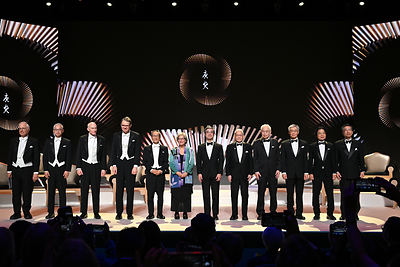
This year marked the first Tang Prize Award Ceremony since the passing of Tang Prize Founder Dr. Samuel Yen-Liang Yin, and a commemorative video was shown in his honor. Dr. Chung-Yao Yin, Chairman of the Tang Prize Foundation, said his father established the Tang Prize to recognize research achievements and practical contributions that have made a significant impact on human society, with the hope of helping guide the world toward sustainable development. Although his father is no longer with us, he said, the framework and spirit he established will continue to be carried forward, and this year's ceremony represents a continuation of the vision on which the Tang Prize was founded.
Academician Chi-Huey Wong, President of the Tang Prize Selection Committee, said that the selection committees for all four prize categories have consistently upheld objective, impartial, and professional standards in selecting laureates. He noted that the outstanding achievements of this year's laureates continue to have a far-reaching impact on human health, environmental sustainability, scholarly research, and social justice.
Professor Susan Solomon, the 2026 Tang Prize Laureate in Sustainable Development, recalled how the discovery of the Antarctic ozone hole in 1985 galvanized scientists around the world to search for answers and spurred the international community to act. The Montreal Protocol was ultimately ratified by all 197 nations in the UN, and today, she said, "the ozone hole is indeed starting to slowly recover, just as expected." Solomon noted that today's global environmental challenges may likewise seem intractable, but a combination of "science, public engagement, industry participation, and wise policy" once enabled humanity to overcome the crisis of ozone depletion. She closed by expressing her hope that humanity will again succeed in "the moonshot of safeguarding our environment instead of destroying it."
Among the 2026 Tang Prize Laureates in Biopharmaceutical Science, Dr. Steven A. Rosenberg recalled that when he began working in the field 40 years ago, there was no effective immunotherapy for cancer in humans. His team's work showed that tumor-infiltrating lymphocytes (TILs) grown from patients with melanoma and infused back into the same patients could mediate regression of their cancer, demonstrating that "the patient's own lymphocytes could be used as a living drug to treat their disease." That work later led to therapeutic strategies using T cell receptors (TCRs) and chimeric antigen receptors (CARs). Rosenberg called the work "a proud example of academic research" that ultimately led to lifesaving cancer treatments now available worldwide.
Dr. Michel Sadelain recalled that the idea of targeting CD19 with CAR T cells in the 1990s was rejected by most in academia and industry. He said the only way to advance the concept was to "do it yourself." His team treated its first patient in 2007, and the first CD19-targeted CAR therapies were approved by the U.S. Food and Drug Administration in 2017. Today, hundreds of laboratories around the world are exploring the potential of CAR T cells. Following their success in certain leukemias and lymphomas, multiple myeloma became the next cancer to be successfully treated with CAR T cells, which are now also showing promise in rheumatology and other fields. Sadelain expressed particular gratitude to "the brave ones who risked their careers when this work was labelled 'science fiction.'"
Dr. Carl H. June said that for patients in the early clinical trials, the question was not whether CAR T-cell therapy was an elegant scientific idea, but whether it could give them more time: "Time with a spouse. Time to see a child grow up. For a child, time simply to grow up." When patients who had exhausted their treatment options entered lasting remissions, he said, something first imagined in the laboratory "had become a future that a family could begin to imagine again." June said that patients and their families are "at the heart of this award." "They trusted us when there was far more uncertainty than reassurance. We owe them a debt that no prize can repay," he said. He also stressed that "a treatment cannot change a life if it never reaches the person who needs it. Access must be part of our definition of success."
Professor Ge Zhaoguang, the 2026 Tang Prize Laureate in Sinology, reflected on nearly half a century of historical research, from his early work on Chan Buddhism and Daoism to Chinese intellectual history, and later to "viewing China from its periphery," asking "What is China?" and advocating "a global history from the Chinese perspective." All of these, he said, have been attempts to respond through scholarship to an age of constant change. He recalled that the generation of scholars who came of age in the 1980s endured hardship, shouldered great responsibilities, and held high ideals, which, he said, gave the study of traditional China during that period a spirit of "exuberant intellectual vitality." Today, he said, Sinology has become a global field of scholarship. Perspectives from different countries and regions are like mirrors held at different angles, together revealing a China that is nuanced and multifaceted. In his view, "the synthesis of East and West, together with pluralism and openness," is the path toward a flourishing field of Sinology.
Professor Bruce Ackerman, the 2026 Tang Prize Laureate in Rule of Law, reflected on how his parents' families had fled Europe to escape anti-Semitic persecution and how he grew up in one of New York City's most impoverished neighborhoods in the 1950s. Although his parents repeatedly warned him against overly ambitious dreams such as attending Harvard, his experience in public schools shaped by John Dewey's philosophy of progressive education encouraged him to explore alternative paths to self-definition, examine different possibilities, and think independently. He ultimately applied to Harvard, where he was deeply influenced by John Rawls. Speaking of Dewey, Ackerman said, "Without his vision of progressive education, I would not have had the opportunity to propel myself beyond my impoverished neighborhood in New York and begin my search for a meaningful scholarly existence." To this day, he continues to collaborate with colleagues at Yale Law School and other universities to explore the underlying sources of the worldwide crisis threatening the future of the rule of law.
The ceremony concluded with performances by the Taipei Philharmonic Orchestra of Dmitri Shostakovich's Festive Overture, Op. 96; Shu-Si Chen's "Tung Flower" Suite; and Pyotr Ilyich Tchaikovsky's Marche Slave, Op. 31. The musical tribute honored the outstanding achievements of the six laureates and brought the ceremony to a fitting close.
Note: Livestream (Original Audio): https://youtube.com/live/DYKirmt37DI?feature=share
Livestream (Chinese Interpretation): https://youtube.com/live/DEx3RGi82j0?feature=share
 View original content to download multimedia:https://www.prnewswire.com/news-releases/2026-tang-prize-award-ceremony-honors-six-laureates-302883215.html
SOURCE The Tang Prize Foundation

