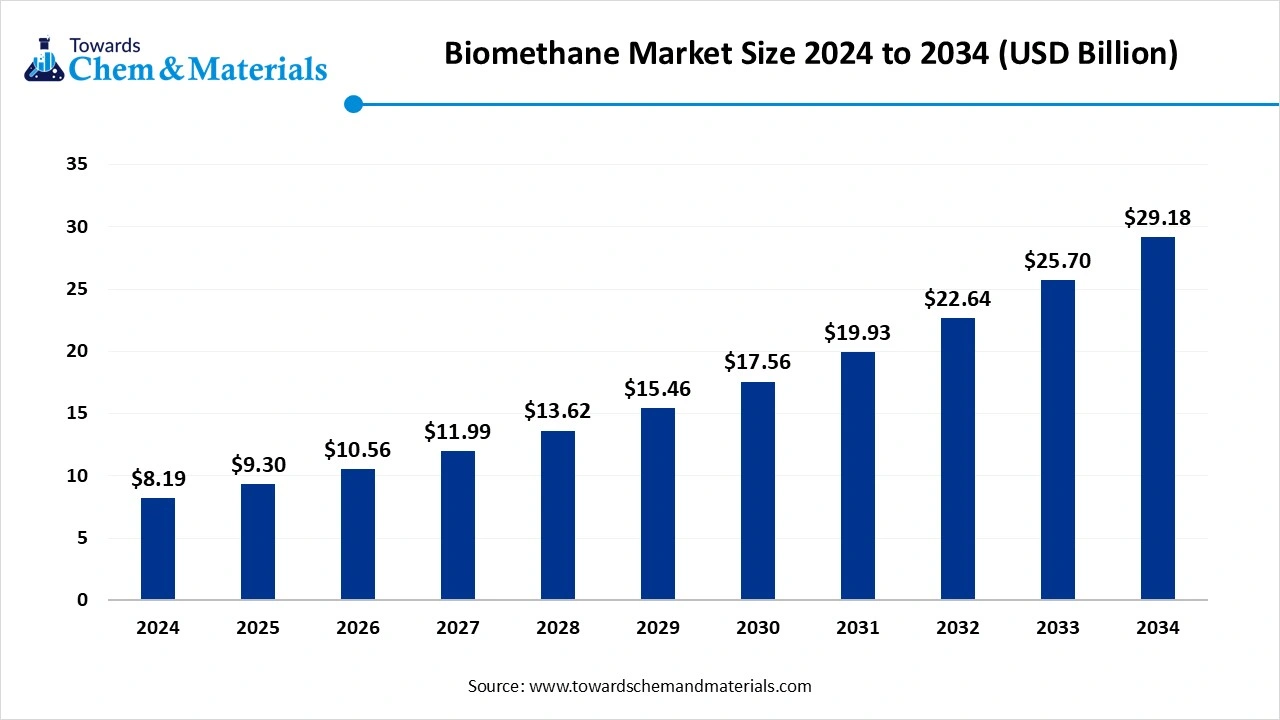
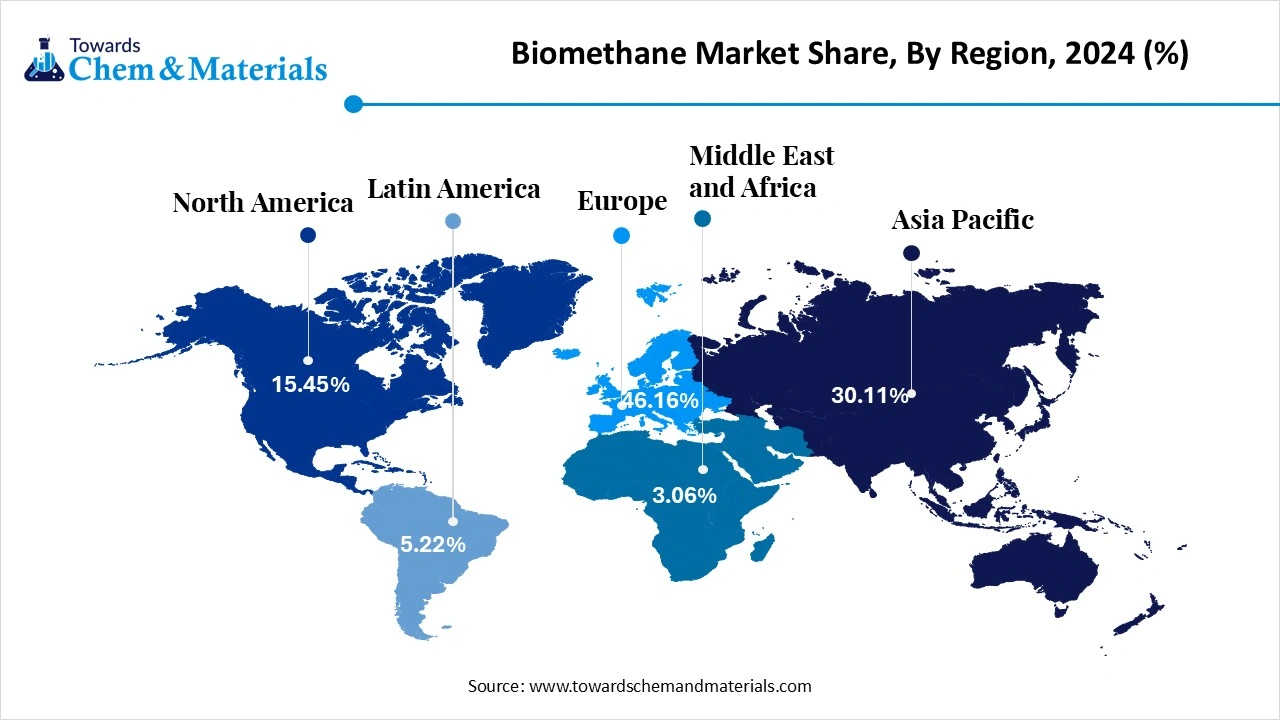
Ottawa, Dec. 12, 2025 (GLOBE NEWSWIRE) -- According to Towards Chemical and Materials Consulting, the global biomethane market size reached at USD 9.30 billion in 2025 and is predicted to increase by USD 10.56 billion in 2026 and is expected to be worth around USD 29.18 billion by 2034, exhibiting at a compound annual growth rate (CAGR) of 13.55% over the forecast period 2025 to 2034. Europe dominated the biomethane market with a market share of 45.16% the global market in 2025. Rising global demand for renewable and low-carbon energy sources is a key factor driving growth in the biomethane market. A study published by Towards Chemical and Materials a sister firm of Precedence Research.
Download a Sample Report Here@ https://www.towardschemandmaterials.com/download-sample/5619
What is Biomethane?
The biomethane market serves as a renewable energy alternative derived from organic waste, using processes like anaerobic digestion and gas upgrading to produce clean methane. It offers environmental benefits by shutting down carbon emissions, reducing reliance on fossil fuels, and enabling waste-to-energy and circular economy practices.
Biomethane finds applications across power generation, heating, industrial energy, transportation fuel, and construction, showcasing its versatility. The market is expanding due to rising environmental awareness, supportive government policies for renewables, technological improvements lowering production costs, and increasing availability of organic feedstock.
Request Research Report Built Around Your Goals: sales@towardschemandmaterials.com
Biomethane Market Report Highlights
- Europe biomethane market dominated the global industry and accounted for over 45.16% revenue share in 2025.
- The biomethane market in North America is anticipated to witness a CAGR of 13.69% over the forecast period.
- The Municipal waste accounted for the highest revenue share of about 42.11% in 2025.The municipal waste segment is expected to register the fastest CAGR of 14.75% during the forecast period.
- The Construction accounted for the highest revenue share of over 41.19% in 2025. According to the IEA, bioenergy accounted for around 15% of the world’s primary energy demand in 2025.
Uses and applications of biomethane
As it has a composition and energy power very similar to those of fossil natural gas, biomethane can be used for the same purposes:
- Alternative to natural gas: It can be injected into the gas network to replace natural gas (it is mixed with this in any proportion) and distribute it for both residential and industrial consumption. This makes it possible to make the most of existing infrastructure.
- Generate electricity and heat: Its combustion also serves to generate electricity and heat. In this case, biogas is usually directly used without the need to purify it to biomethane.
- Power vehicles: In fact, the use of biomethane as an advanced renewable biofuel enables an improvement in air quality as it emits less greenhouse gases, in a way that it becomes a great ally in the energy transition as a renewable fuel. The use of compressed natural gas or CNG is on the rise among, for example, urban bus fleets.
- Raw material: As a raw material, for example, for the production of renewable hydrogen.
- Create employment: The production of biomethane leads to further development of rural areas and increases the creation of jobs related to the agricultural and livestock sectors. Moreover, its self-consumption helps to reduce carbon emissions in the agro-livestock sector, contributing to its environmental balance.
- Boost the circular economy: As it allows efficient management and harnessing of organic waste, since the digestates obtained are returned to the field as fertilizers.
- Waste use: Lastly, the using waste to produce local energy contributes to the energy dependency reduction plan in Europe
The production of hydrogen from biomethane
Renewable or green hydrogen (i.e., free of emissions) is today considered a key player in the decarbonization of certain sectors that are very difficult to electrify, such as heavy industry or long-distance transportation, so it's crucial to find ways to produce it with the lowest possible impact.
In this regard, Repsol has announced the production of renewable hydrogen with biomethane as a raw material. This feat has taken place at the Repsol plant in Cartagena, where 10 tonnes of renewable hydrogen has been produced from 500 MWh of biomethane. It's a truly remarkable first step in replacing the conventional natural gas needed to produce hydrogen at the existing facilities for biomethane from a renewable source.
The production of renewable hydrogen by this method is another example of Repsol's effort to transform its industrial complexes into multi-energy hubs capable of generating decarbonized products. It's part of its circular economy strategy that, since 2018, is committed to using waste as a raw material for its products. As a leader in the production and consumption of hydrogen in Spain, Repsol dedicates a large part of its efforts to promoting large-scale industrial projects such as the Basque Hydrogen Corridor, the Hydrogen Valley of Catalonia, the Hydrogen cluster in Castilla-La Mancha, and the Renewable Hydrogen Hub in Cartagena, while it promotes several technologies to achieve its renewable hydrogen production objectives.
Immediate Delivery Available | Buy This Premium Research Report@ https://www.towardschemandmaterials.com/checkout/5619
Biomethane Market Report Scope
| Report Attribute | Details |
| Market size value in 2026 | USD 9.05 billion |
| Revenue forecast in 2034 | USD 17.03 billion |
| Growth rate | CAGR of 13.5% from 2025 to 2034 |
| Base year for estimation | 2025 |
| Historical data | 2019 - 2025 |
| Forecast period | 2025 - 2034 |
| Segments covered | By Source, By End Use, By Region |
| Regional scope | North America; Europe; Asia Pacific; Latin America; Middle East & Africa |
| Country scope | U.S.; Canada; Mexico; Germany; France; Italy; Denmark; Netherlands; China; India; Japan; South Korea; Brazil; Argentina; South Africa; Saudi Arabia. |
| Key companies profiled | Air Liquide; Engie; Nature Energy Biogas A/S; Gasum; Terega Solutions; Waga Energy; TotalEnergies; Chevron; Kinder Morgan; Archea Energy; Envitec Biogas AG; Future Biogas Ltd.; E.ON SE; Verbio Vereinigte Bioenergie AG; South Hills RNG |
For more information, visit the Towards Chemical and Materials website or email the team at sales@towardschemandmaterials.com| +1 804 441 9344
We can meet REPowerEU biomethane production target
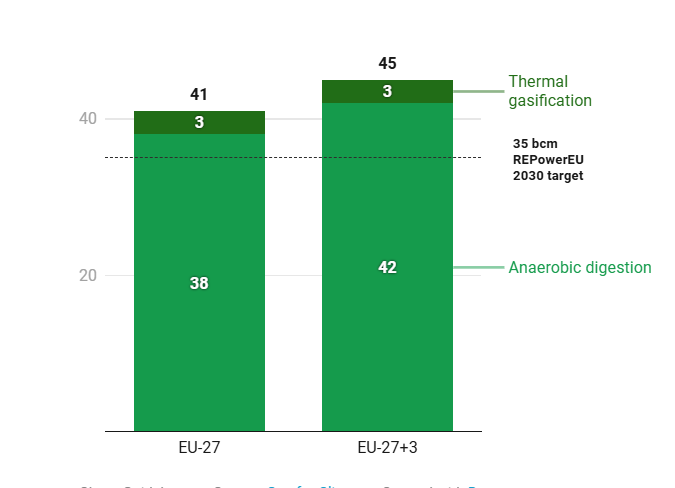
Today, 3 bcm of biomethane and 15 bcm of biogas are produced in the EU-27. Our estimation shows that up to 41 bcm of biomethane could be available to meet the REPowerEU 2030 target of 35 bcm. [13]
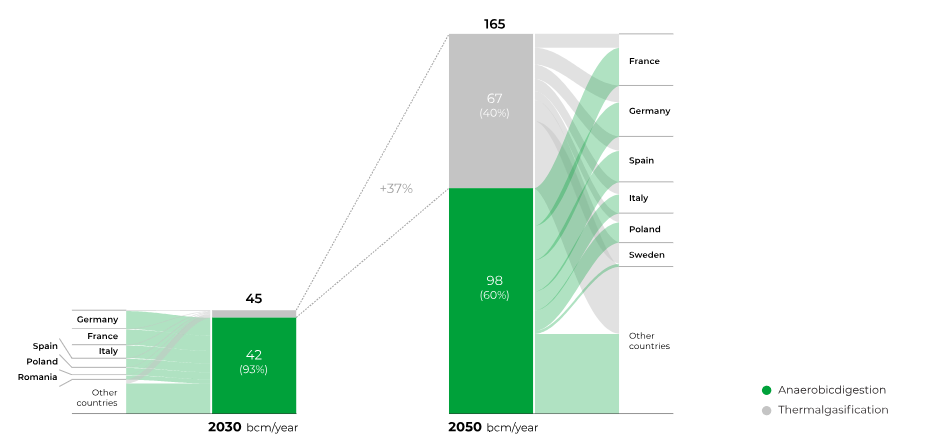
Towards 2030, more than 90% of biomethane will be produced via anaerobic digestion of waste and residual biomass from agriculture, the food industry and municipal waste. [14] Beyond 2030, other technologies such as thermal gasification will help to further increase the potential, to achieve over 1,000 TWh per year by 2050, which would be a substantial share of the future gas mix. [15] , [16]
Significant increase of potential from 2030 to 2050
At a European level, there is significant potential to scale up the production of sustainable biomethane in the coming decades. If the supporting action and policy are deployed, biomethane production potential can increase from 41 bcm in 2030 to 151 bcm in 2050. [17]
Even more biomethane potential can be unlocked by looking at additional feedstocks (e.g. biomass from marginal or contaminated land and seaweed, as noted in the REPowerEU plan [18] ), and technologies (e.g. hydrothermal gasification of wet feedstocks, including organic wastes and residues). Renewable methane (or power to methane), produced from renewable electricity and biogenic CO2 captured in biogas upgrading can furthermore contribute additional potential, as can landfill gas.
Government Initiatives for the Biomethane Industry:
- Sustainable Alternative Towards Affordable Transportation (SATAT) Initiative: This scheme invites entrepreneurs to set up CBG production plants and assures them a long-term offtake agreement and procurement price for the CBG produced by public sector oil marketing companies (OMCs).
- GOBARdhan (Galvanizing Organic Bio-Agro Resources Dhan) Scheme: This initiative aims to manage cattle dung and organic waste in rural areas by converting them into biogas/CBG and compost, providing financial assistance for establishing plants.
- National Bioenergy Programme: The Ministry of New and Renewable Energy (MNRE) provides central financial assistance (CFA) as a capital subsidy to project developers for setting up biomethane/biogas generation plants from urban, industrial, and agricultural waste.
- CBG Blending Obligation (CBO): The government has introduced a phased mandatory blending of CBG into Compressed Natural Gas (CNG) and Piped Natural Gas (PNG) networks, starting from 1% in FY 2025-26 and increasing to 5% by 2028-29, to create a sustained demand for biomethane.
- Market Development Assistance (MDA) for Organic Fertilizers: To enhance the economic viability of CBG plants, the Ministry of Agriculture provides MDA to support the marketing and sale of fermented organic manure (FOM) produced as a byproduct.
What Are the Major Trends in the Biomethane Market?
- Growing emphasis on renewable energy and clean fuels is driving strong demand for biomethane as an environmentally friendly alternative to fossil fuels.
- Rising interest in circular economy approaches, converting organic waste into energy, is promoting biomethane adoption worldwide.
- Technological improvements in production processes, such as more efficient anaerobic digestion and gas upgrading systems, are making biomethane more cost-effective and scalable.
- Expanded cross-sector applications from power generation and heating to transport fuel, industrial use, and construction are broadening the market’s reach and driving growth.
How Does AI Influence the Growth of the Biomethane Industry in 2025?
AI-driven systems are reshaping the biomethane industry by enabling real-time monitoring and fine-tuned control of complex anaerobic digestion and gas upgrading processes. With continuous data input from sensors covering factors like feedstock quality, digester conditions, gas composition, and equipment performance, AI models can dynamically adjust operating parameters to maximise methane yield, enhance process stability, and ensure consistent gas quality.
At the same time, AI enables predictive maintenance that identifies potential equipment failures or process deviations before they happen, reducing downtime and minimizing waste or safety risks.
Market Opportunity
Can Drive Precision Make Waste to Gas for More Reliable?
AI systems now assess the quality and composition of organic waste and dynamically adjust feedstock blends and digestion parameters. This means biomethane-producing plants can handle variable waste inputs and still deliver consistent methane yield and stable operations.
Could Smart Maintenance and Monitoring Cut Downtime and Boost Output?
With AI-enabled real-time monitoring of digester conditions, gas composition, and equipment status, plants can detect issues early before breakdowns occur. That reduces unplanned stoppages, improving safety, and supports continuous, efficient biomethane production.
Immediate Delivery Available | Buy This Premium Research Report@ https://www.towardschemandmaterials.com/checkout/5619
➤ Contact Us: sales@towardschemandmaterials.com | ☎ +1 804 441 9344
Biomethane Market Segmentation Insights
Segmental Insights:
Source Insights:
The municipal waste segment dominated the biomethane market in 2025. In many regions, municipal waste yields a steady and abundant supply of organic feedstock, making anaerobic digestion and upgrading more predictable and cost-effective than other sources. The reliance on municipal waste ensures stable operations for biomethane production plants, supporting demand from power generation, heating, transport, and other sectors, which reinforces the established position of this source in the overall biomethane supply chain.
The wastewater sludge segment is projected to grow at the fastest rate during the forecast period. This trend reflects increasing efforts to harness wastewater treatment by-products as a renewable energy resource, turning sludge once considered waste into valuable biomethane. As wastewater treatment infrastructure expands globally and environmental regulations tighten, more facilities are likely to adopt sludge-to-gas systems, driving rapid growth of this source segment.
End-Use Insights:
The construction segment dominated the biomethane market in 2025. In many countries, construction activities demand reliable energy for heating, electricity, and onsite utilities; biomethane offers a cleaner alternative to traditional fossil fuels for such needs. The ability to supply energy consistently and reduce carbon footprint aligns well with increasing sustainability standards in construction projects, making biomethane a preferred energy source for construction-related end-use.
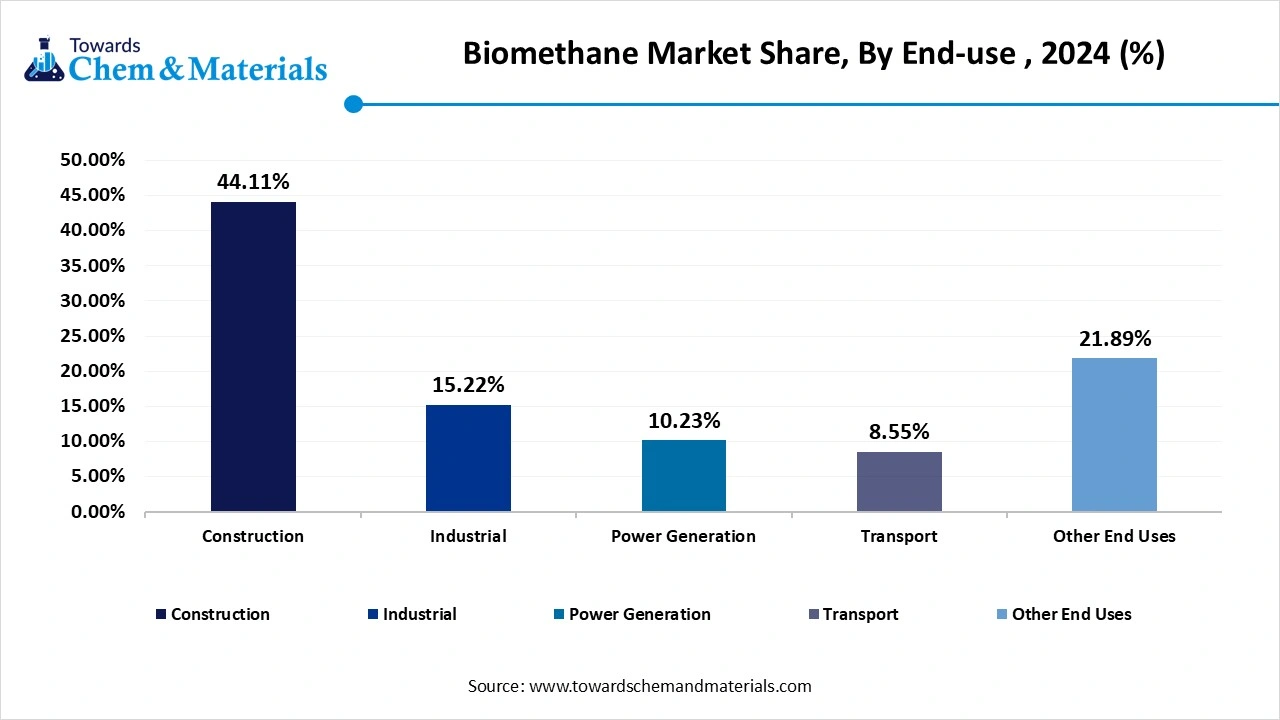
The industrial segment is expected to grow at the fastest rate during the forecast period. Industrial users increasingly seek renewable and low-carbon energy sources for processes, heating or power, and biomethane represents a viable alternative to natural gas in many cases. As industries expand their sustainability initiatives and decarbonisation goals, adoption of biomethane for industrial energy needs is likely to accelerate, fuelling the growth of this end-use segment.
Regional Insights
What Makes Europe Dominate the Biomethane Market?
The Europe biomethane market is expected to increase from USD 4.29 billion in 2025 to USD 13.48 billion by 2034, growing at a CAGR of 13.56% throughout the forecast period from 2025 to 2034.
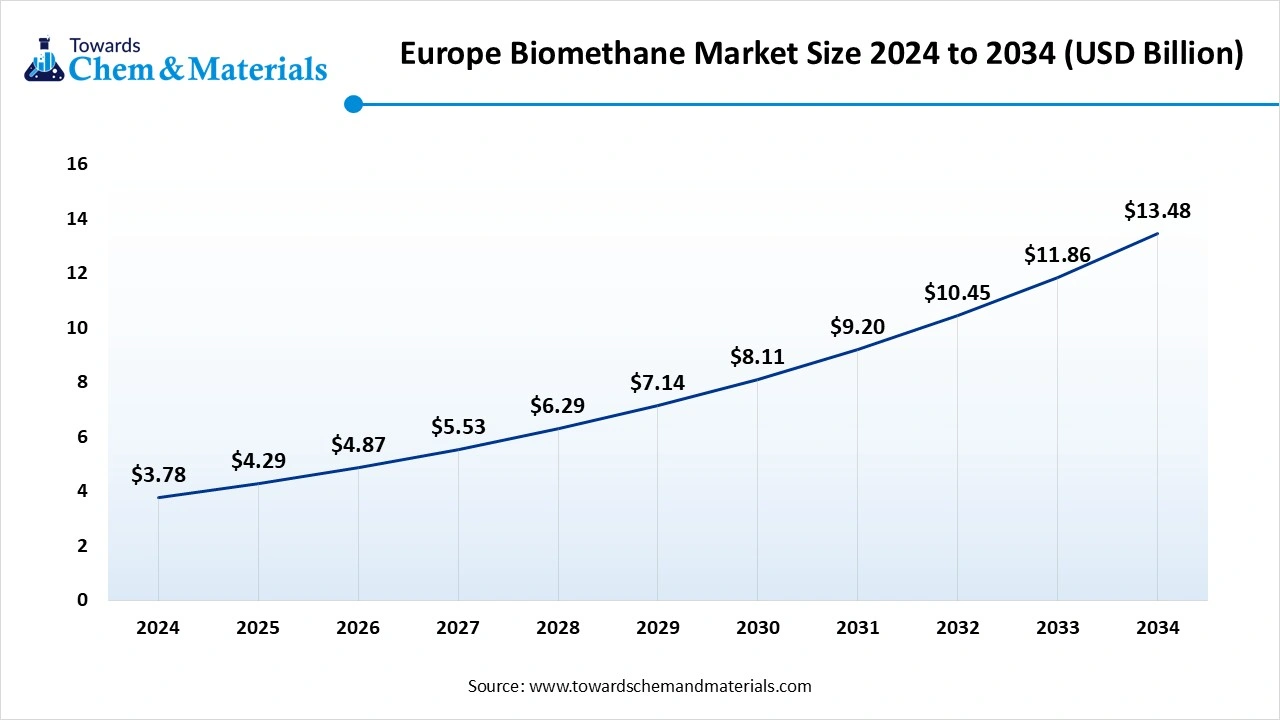
Europe remains the strongest in the market thanks to widespread adoption of biomethane production units, mature waste-to-energy infrastructure, and supportive environmental and energy policies that prioritise low-carbon fuels. In many European countries, biomethane is increasingly used for energy generation, transport fuel, and grid injection, which helps meet sustainability and decarbonisation goals, boosting both supply and demand across the region.
The UK Biomethane Market Trends
The UK market in 2025 is shaped by accelerating decarbonisation policies, particularly the Green Gas Support Scheme, which continues to incentivize new anaerobic digestion (AD) and biomethane-to-grid projects. Rising demand from the transport sector, especially for renewable natural gas (RNG) in heavy-duty vehicles, is boosting production capacity and long-term offtake agreements. Utilities are increasingly integrating biomethane into gas grids to reduce reliance on fossil gas and meet renewable gas blending targets.
What Makes the Biomethane Market in North America the Fastest-Growing Region?
North America is witnessing rapid expansion in biomethane infrastructure and demand, driven by growing industrial and energy sector interest in renewable natural gas (RNG) and cleaner fuel alternatives. According to the analysis from the same source, increasing investments in waste processing, including landfill gas recovery, agricultural waste digestion, and municipal waste treatment, are boosting biomethane production capacity across the region.
U.S. Biomethane Market Trends
Within North America, the U.S. stands out as a core market out as a core market due to its extensive expansion of biomethane plants, strong uptake in various application sectors, and growing municipal waste and organic waste processing capacity. The maturity of its waste-to-energy infrastructure, combined with supportive policies for biofuel and renewable gases, makes the U.S. a central hub for biomethane growth.
More Insights in Towards Chemical and Materials:
- Agricultural Biologicals Market Size to Hit USD 68.36 Bn by 2035
- Biopolymer Coatings Market Size to Reach USD 109.08 Bn by 2035
- Biohydrogen Market Size to Surpass USD 157.80 Million by 2035
- Biofuels Market Size to Reach USD 326.99 Billion by 2035
- Advanced Biofuels Market Size to Surpass USD 3,004.03 Bn by 2035
- Biofertilizer Market Size To Hit USD 11.08 Billion by 2035
- Bio-Based Polypropylene Market Size to Hit USD 6,977.54 Mn by 2034
- Biopolymers Market Size to Reach USD 53.68 Billion by 2034
- Biodegradable Plastics Market Size to Reach USD 91.26 Billion by 2034
- Bio-Based Platform Chemicals Market Size to Hit USD 48.46 Bn by 2034
- Bio-Based Polymers Market Size to Hit USD 58.36 Billion by 2034
- Biobased Adhesives Market Size to Reach USD 14.66 Billion by 2034
What is Going on Around the Global Biomethane Industry?
- In April 2024, France-based AirLiquide announced the expansion of its production capacity of biomethane in the U.S. with the construction of two new plants in Pennsylvania and Michigan. These plants will cater to the industrial and transport sectors in the region.
- In December 2025, a Dutch developer secured a substantial loan from the EBRD to build a biomethane plant in Latvia, aiming to boost renewable gas production and strengthen supply infrastructure in the region. A €17.4m senior loan from the EBRD was secured by the Dutch family-owned holding company HoSt.
- In October 2025, Uniper and Five Bioenergy signed a multi-year contract for biomethane from Spanish plants. Uniper has backed a shift toward low-carbon gas supply for the energy and transport sectors.
Biomethane Market Top Key Companies:
- Air Liquide
- Engie
- Nature Energy Biogas A/S
- Gasum
- Terega Solutions
- Waga Energy
- TotalEnergies
- Chevron
- Kinder Morgan
- Archea Energy
- Envitec Biogas AG
- Future Biogas Ltd.
- E.ON SE
- Verbio Vereinigte Bioenergie AG
- South Hills RNG
Biomethane Market Report Segmentation
This report forecasts revenue growth at global, regional, and country levels and provides an analysis of the latest industry trends in each of the sub-segments from 2019 to 2035. For this study, Towards Chemical and Materials has segmented the global Biomethane Market
By Source
- Energy Crops
- Animal Manure
- Municipal Waste
- Waste Water Sludge
- Other Source
By End-use
- Construction
- Industrial
- Power Generation
- Transport
- Other End Uses
By Regional
- North America
- Europe
- Asia Pacific
- Latin America
- Middle East & Africa
Immediate Delivery Available | Buy This Premium Research Report@ https://www.towardschemandmaterials.com/checkout/5619
About Us
Towards Chemical and Materials is a leading global consulting firm specializing in providing comprehensive and strategic research solutions across the chemical and materials industries. With a highly skilled and experienced consultant team, we offer a wide range of services designed to empower businesses with valuable insights and actionable recommendations.
Our Trusted Data Partners
Towards chem and Material | Precedence Research | Statifacts | Towards Packaging | Towards Healthcare | Towards Food and Beverages | Towards Automotive | Towards Consumer Goods | Nova One Advisor | Nutraceuticals Func Foods | Onco Quant | Sustainability Quant | Specialty Chemicals Analytics | TCM Blog
For Latest Update Follow Us: https://www.linkedin.com/company/towards-chem-and-materials/
USA: +1 804 441 9344
APAC: +61 485 981 310 or +91 87933 22019
Europe: +44 7383 092 044
Email: sales@towardschemandmaterials.com
Web: https://www.towardschemandmaterials.com/