Now it gets real: Real money, real investment decisions, Rutgers Business School students launch $1 million Scarlet Student Fund
PR Newswire
NEWARK, N.J., April 27, 2026
Inspired by his work with a professor, an alumnus gives $1 million to provide Rutgers Business School students with a unique experience to work as stock analysts and portfolio managers.
NEWARK, N.J., April 27, 2026 /PRNewswire/ -- When Rutgers University alumnus Daniel Davidowitz started guest lecturing in Professor Rose Liao's MBA finance class, he wanted to supplement the academic instruction on equity research and portfolio management techniques with real world practices.
His interest in making Rutgers Business School MBA finance classes more meaningful didn't stop with lectures. Driven by a desire to enrich students with experiential learning, Davidowitz, a portfolio manager at Polen Capital Management, worked with Liao and Rutgers to establish a $1 million student-managed fund that is supported by a high-level finance course.
- An alum's gift to Rutgers Business School provides students with experience managing a million-dollar investment portfolio.
- High-level finance course built around the fund demonstrates the power of teaching academics combined with a portfolio manager's expertise.
- Rutgers Business School students value experiential learning. Managing the Scarlet Fund class provides them with real-world investment experience using actual dollars and a responsibility for the fund's success. "It's so hands-on," said one MBA student.
"The idea is to bring the real world into academics," Davidowitz said. "You learn how to pick stocks and manage a portfolio but if you're not doing it with money, there's nothing tangible to it. If someone gives you money to manage, now you care about it."
Students Become Founders of an Investment Fund
It was nearly the end of the fall semester when a rare class of both graduate and undergraduate students met on campus to mark a milestone in Rutgers Business School's new Managing Scarlet Student Fund class.
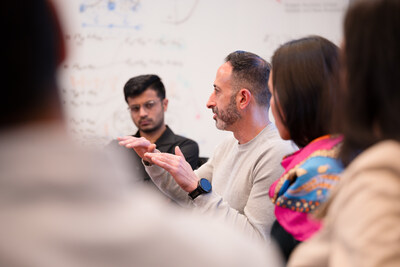
The students sounded like analysts taking turns giving updates on the companies and industries they had researched during the semester. Some issued ratings on stocks. Votes were cast. The students talked about management moves, stock sales by executives, and industry trends. At the head of the classroom were Professor Liao and Davidowitz, who listened, intermittently offering insights and posing questions.
After a semester of work, the class had decided (by majority vote) to make their first investments, mostly stalwart companies like VISA, Meta Holdings and Johnson & Johnson. Before the in-person class ended, Liao and Davidowitz took another step in establishing the fund: Five of the founding students were named to serve as portfolio managers.
"Now," Davidowitz said, grinning, "it's going to get real."
The Partnership of Davidowitz and Liao
After Davidowitz's first visits as a guest lecturer in her Advanced Corporate Finance class, Liao said she realized her students wanted more of the perspective he brought. "They didn't want more lessons on the capital asset pricing model or modern portfolio theory," she said. "They wanted to hear more of what's going on in the real world."
Liao and Davidowitz talked about what else they could do. Establishing a student-managed investment fund with a two-semester class constructed around it took more than a year to become a reality. Davidowitz described the class designed by Liao as "well thought out and structured." The class also differentiates the Scarlet Fund among student-managed funds at other schools.
As much as Davidowitz enjoys his engagement with students, for him, the donation was also about stepping up as an alumnus. "I loved my time at Rutgers," he said. "This allowed me to give back."
Davidowitz grew up in Marlboro, New Jersey. As a rising college sophomore, he transferred to Rutgers College from SUNY-Albany and dropped pre-med for studies in hospital administration and public health. After graduating in 1995, he worked at Sloan-Kettering Cancer Center in audit and analytics roles. Meanwhile, the dot-com bubble was turning everyone into market watchers, and Davidowitz got caught up the fervor. He said his "fascination" with stocks motivated him to go back to school. He earned his MBA from Baruch College going to classes part-time while he continued working. He's 52 now and has spent two decades at Polen Capital Management.
Launching the Scarlet Student Fund
The experience of completing an MBA part-time influenced the way he thought about the Scarlet Fund. He wanted part-time MBA students to be included. At schools where you find student-run investment funds, they're usually geared toward the full-time MBAs, he said. "I was a part-time MBA student, and I know what it's like. You are left out of things," he said. "I didn't want that to happen with this."
Still, he and Liao decided to open the Scarlet Fund class to other graduate students and select undergraduates studying finance. "We thought that a merging of minds would be a great thing," Liao said. "We thought about continuity. The classes are meant to be taken sequentially, but we will bring more analysts in (this semester) and they will be guided by the students who were in the first class."
The first class of 16 students have the distinction of being the fund's founders. Part-time MBA students helped to select their classmates – a mix of Full-Time MBAs, graduate students studying to be quants, and undergraduate honors students majoring in finance.
When the class started, Liao told students to think of it like an internship. The idea is that students will learn the skills of analysts and managers as they do the work of managing the fund. Davidowitz, who teaches the class with Liao as an executive in residence, believes the students are learning robust skills that will prepare them for careers in corporate finance and business development, and for roles as research analysts or portfolio managers.
The students were divided into teams and assigned an industry at the start of the semester. They chose companies and studied them. As the semester went on, the students took turns pitching stocks of the companies they had chosen. Thousands of companies were screened, narrowed down to hundreds and then even fewer for the students to select from. The students heard a total of 20 pitches and chose to invest in less than half of them. About a quarter of the $1 million was invested by the founding students during the first class, according to Liao.
Each semester, students will continue learning how to evaluate industries and individual stocks as they make more equity investments. They will have to determine if the portfolio is properly balanced. Eventually, they may decide to include other types of investments.
Since its inception in mid-January, the Scarlet Fund has navigated a period of heightened market volatility. According to Caliph Mohammed, one of the student portfolio managers, the fund demonstrated a relative outperformance of 2.7% against the S&P 500 and 2.9% against the Russell 1000.
"With approximately 24% of capital deployed in equities and 76% held in cash, the overall portfolio declined by 1.3% despite the broader market selloff," Mohammed wrote in an email. "This highlights the impact of disciplined capital allocation and risk management, with the cash reserve providing meaningful downside protection during volatile market conditions."
While the students are given freedom to make decisions about the fund, Liao and Davidowitz are there to provide guardrails. "We give them constant feedback," Liao said. "The feedback loop is one of the most important parts of their learning."
The goal is to grow the Scarlet Fund to $5 million before any of the money is spent. When it is, it will fund scholarships and support student activities like networking events that will help the students managing the Scarlet Fund to meet professionals and land jobs.
Lei Lei, dean of Rutgers Business School and an advocate of experiential learning, immediately supported the fund.
"Many of our students will be enriched by the opportunity the Scarlet Fund offers them to experience what it's like to work on a real investment management team," Lei said. "The creation of this fund and the related classwork is a great example of generosity, innovation and collaboration."
"It will strengthen Rutgers Business School's emphasis on experiential learning as an important way of preparing students for careers and career promotions," she said.
As the flagship business school of New Jersey, Rutgers Business School is constantly innovating to provide a strong return on investment for students.
The Benefit of Experiential Learning
Eric Nieves works full-time as an associate at RBC Capital Markets and is pursuing his Rutgers MBA as a part-time student. He's focusing his studies on finance with the hope that he'll be able to move up in the company.
"The Scarlet Fund is a course that fits exactly how I want to learn," Nieves said. "You have the academic part with Professor Liao teaching us how to value a company and all of the things you expect to learn in a high-level finance course, and then you get amazing real-world insights from Dan, who is an actual expert in this.
"It's like you're working under them," he said. "It's a really cool environment to be in."
The Managing Scarlet Student Fund class is largely online. Twice during the fall semester, the students came together for an in-person class. There was an excitement about the in-person classes, students said. On those occasions, Davidowitz arrived at Rutgers Business School's building in Piscataway after a flight from Florida.
MBA student Barbie Tyagi didn't have a finance background, but the class offered her a chance to have Liao as a professor – something her MBA classmates had encouraged her to do if she could.
"One of the things I love about this class is it's so hands on," Tyagi said. "We're trying to assess the company, whether it's fundamentally good or bad, whether we want to have it in our portfolio or not. It's very much experiential learning."
Aryan Gurusamy is an undergraduate finance student in the Road to Wall Street Program, which has helped him to get working experience in investment banking and venture capital. Learning how to evaluate companies and analyze stocks was new for him.
Gurusamy said the class enhanced his textbook learning of how the markets work. In other classes, he learned quantitative methods. "It's much more qualitative than I actually thought," he said. Along with analysis, he said he's learned to look at things like company leadership and industry trends.
The students said they felt a sense of responsibility to ensure the fund did well. "I'm pretty confident we're going to be successful," Nieves said. "It's a legacy I'm going to be proud of."
Tyagi agreed. "(Dan) believed in us by donating the money and the things that can be done with the money. I think this is what drives us all," she said. "We are working toward something that will have a measurable impact."
A Realization About Giving Back
Philanthropy isn't new to Davidowitz and his family. In 2024, they funded 65 scholarships for high school students in Florida who are caregivers of sick or disabled family members. He's more math and science oriented and his wife is more artistic, so their giving is typically directed to scholarships for high school students in both those areas, he said.
It was only recently that Davidowitz learned how vital alumni giving is to Rutgers University. "In my mind, I thought about 80 percent of the Rutgers budget was state money," he said. "I learned that portion decreases every year and most of the university's budget comes from student tuition. When I think about the incredibly high return on investment I got, to not give back would have been a crime." As of July 2025, the State of New Jersey provides approximately 18 percent of the University's budget.
How will he measure the success of the Scarlet Fund?
"For me, I think success is, do the students learn something that they wouldn't have without it or maybe qualify for a job that they might not have qualified for without it," Davidowitz said.
"In my mind, it's much more about how it impacts the students and what kind of path it puts them on and what kind of knowledge they gain," he said. "Secondarily, I would love for the fund to do very well."

 View original content to download multimedia:https://www.prnewswire.com/news-releases/now-it-gets-real-real-money-real-investment-decisions-rutgers-business-school-students-launch-1-million-scarlet-student-fund-302753716.html
SOURCE Rutgers Business School

